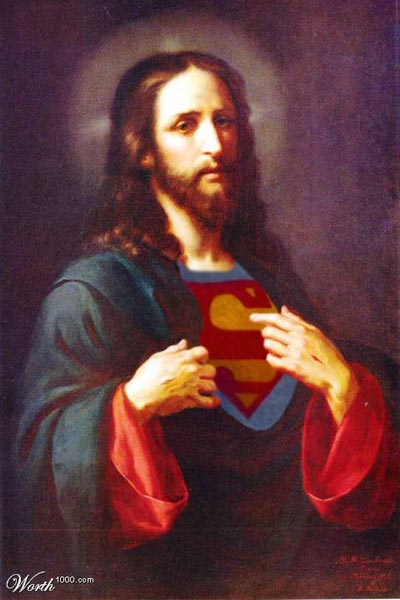
Talking to the press this week about Christological images in the latest Superman movie was an unexpected gift. It reminded me of a book I read along time ago. Robert Farrar Capon wrote “Hunting the Divine Fox.” In this book he has a chapter called Superman. In it he writes:
“The true paradigm of the ordinary American view of Jesus is Superman: ‘Faster than a speeding bullet, more powerful than a locomotive, able to leap tall buildings in a single bound. It’s Superman! Strange visitor from another planet, who came to earth with powers and abilities far beyond those of mortal men, and who, disguised as Clark Kent, mild-mannered reporter for a great metropolitan newspaper, fights a never-ending battle for truth, justice and the American Way.’ If that isn’t popular christology, I’ll eat my hat. Jesus – gentle, meek and mild, but with secret, souped-up, more-than-human insides – bumbles around for thirty-three years, nearly gets himself done in for good by the Kryptonite Kross, but at the last minute, struggles into the phone booth of the Empty Tomb, changes into his Easter suit and, with a single bound, leaps back up to the planet Heaven. It’s got it all – including, just so you shouldn’t miss the lesson, kiddies: He never once touches Lois Lane.”
Capon, as ever, is brilliant. The connection between Superman and Christ maybe subliminal, but it is not new. Capon wrote this in 1977.
Not long after that the movie ET came out by Steven Spielberg. 1982. Strange visitor from another planet comes to earth. He has supernatural healing powers at the tip of his finger. He longs for his home in the heavens. He is persecuted and killed, only to be raised from the dead (wearing a white shroud). At the end of the movie he ascends to his father, but not after promising to come again someday.
The image of the immortal god-man is nothing new. Consider Hercules. The very mortal Alcmene is impregnated by the god Zeus. Their child is true god, true man, not exactly orthodox theology, but close.
Nietzsche talked about the super man. The Nazis took it seriously: an army of genetically pure Übermenschen. By eliminating the racially impure, the Jews, the handicapped, the homosexuals, the dissenters, they would create a master race of supermen.
This story is an archetypal story. It is probably primordial, told around campfires for thousands of years. A single hero with superhuman powers, against all odds vanquishes the forces of darkness, saving the universe from certain destruction. This meta-narrative is the expression of our deepest yearning for justice, immortality and plain old victory.
Thing is, Jesus is not Superman. The gospel is not a story of winners and losers. The foes he vanquishes are not earthly foes, and his victory is not one of strength and power, but of humble service. He reveals the deepest truth about the world by caring for the sick, living among the poor, eating with outcasts and sinners. He touches the untouchable and loves the unlovable. He takes a whip to the money changers in the Temple and proclaims a kingdom of love greater than all earthly kingdoms. It costs him his life. He doesn’t destroy his enemies; he loves them. Christians didn’t defeat the Roman Empire with armies, they won it over with love and sacrifice. Once in power, the church lost its way. It forgot its charter: the meek inherit the earth. This led to the Reformation. We’re entering another Reformation I believe. time to reboot. The church must constantly be re-forming, returning to the way of the cross.
This is the heart of the true faith of Christ: One becomes a great by serving and sacrificing, by being least and last. It’s not about exaltation: striving to be the Superman, but about incarnation: identifying with the underdog.


June 14, 2013 at 11:48 pm
The Christological parallels are obvious to us Christians, but as the character was created by two Jewish teenagers during the Depression, there are obvious Jewish parallels—A baby who is sent down the river in a basket or through the stars in a rocket to eventually become a great leader, for one. Samson, also, is a likely influence on Siegel and Shuster.
June 14, 2013 at 11:58 pm
Absolutely agree Neil. Kal-el is a clear Hebrew reference as well. Whether the christological inferences are intended or not, I think they’re there. They’re part of the air we all breathe, Jews, Christians, atheists. They’ve clearly been exaggerated over the years as others had their way with the original story. We also can’t forget that Jesus himself was Jewish.